
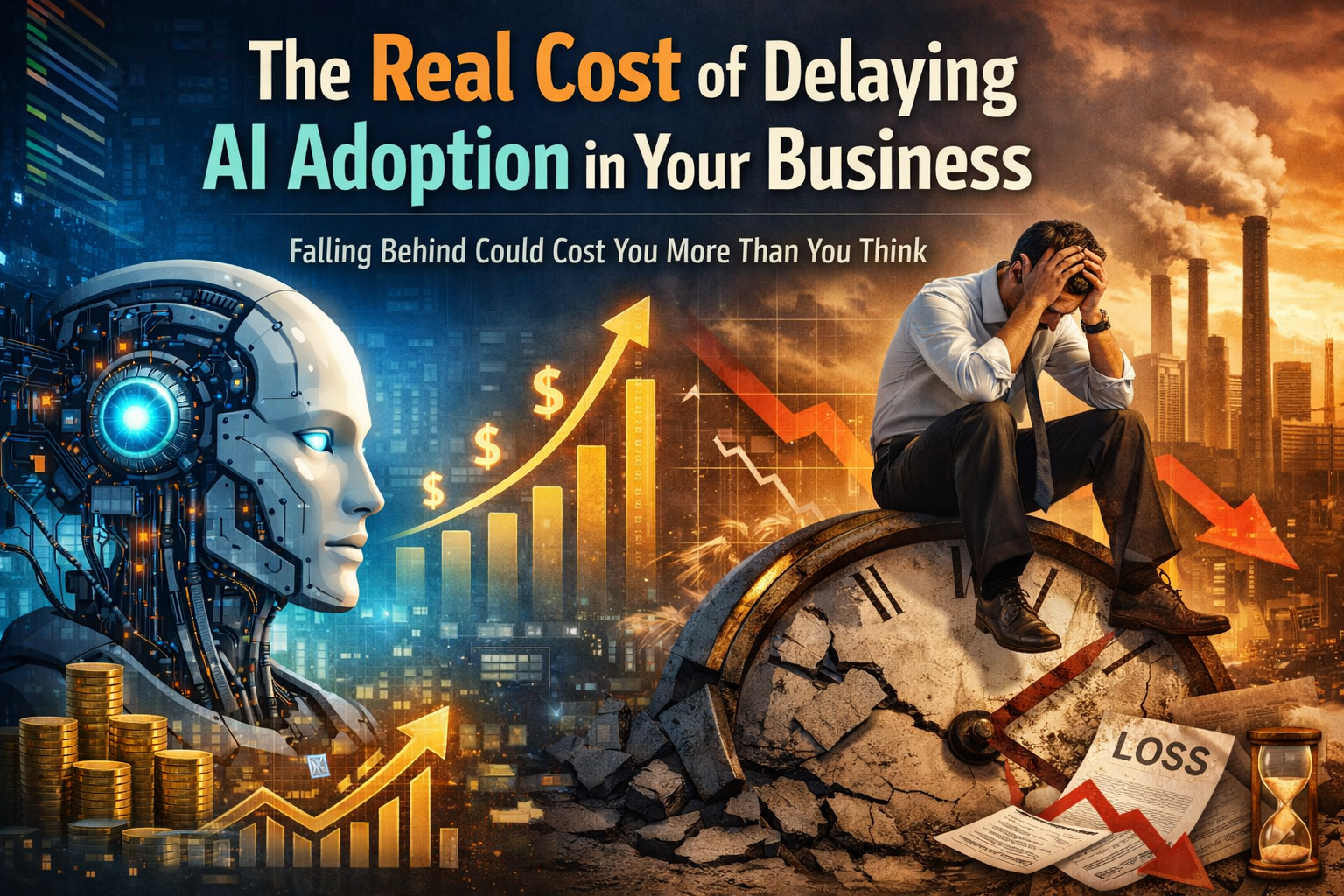
Artificial intelligence is no longer a future initiative, or an experimental tool reserved for large enterprises. It is now a measurable cost control and margin protection lever for growing businesses. The organizations that delay AI adoption are not standing still. They are actively losing money in ways that are often invisible on traditional financial reports.
The most dangerous cost of AI delay is not software spend or implementation complexity. It is ongoing operational waste that compounds every month. Manual work, inefficient processes, slow response times, and underutilized data quietly erode profit while competitors gain efficiency.
If AI is still considered a long-term project or a nice-to-have innovation, there is a high probability your business is already paying for that delay.
AI Delay Is a Cost Problem, Not a Technology Problem
Most leadership teams frame AI adoption as a technology decision. In reality, it is a financial decision with direct impact on operating expenses, labor efficiency, and revenue velocity.
Every manual task that could be automated has a cost. Every delayed decision due to lack of insight has a cost. Every customer interaction that requires human effort instead of intelligent automation has a cost.
These costs do not appear as line items labeled AI delay. They show up as:
- Rising labor expenses without productivity gains
- Slower turnaround times for customers
- Inconsistent execution across teams
- Margin pressure that cannot be explained by sales volume alone
When businesses avoid AI because they fear complexity or disruption, they often accept far greater financial risk by doing nothing.
The Hidden Financial Impact of Manual Work
Manual processes are one of the largest sources of hidden cost in modern businesses. They consume time, require supervision, and introduce errors that lead to rework.
Common examples include:
- Sales teams manually qualifying leads
- Support teams responding to repetitive questions
- Operations teams entering and reconciling data
- Managers compiling reports instead of analyzing insights
Each task may seem small. Combined across departments, these activities represent thousands of hours per year that could be redirected toward revenue-generating work.
AI does not eliminate people. It eliminates wasted effort. Organizations that fail to adopt AI tools continue paying premium labor costs for low-value tasks.
Delayed AI Adoption Increases Labor Costs Without Increasing Output
One of the most significant financial risks of AI delay is labor inefficiency. Hiring additional staff to keep up with workload is expensive, slow, and difficult to reverse.
AI-enabled automation allows teams to handle higher volumes without proportional increases in headcount. Businesses that delay adoption often respond to growth by hiring instead of optimizing.
This creates:
- Higher fixed costs
- Increased management overhead
- Lower scalability
- Reduced profitability during slow periods
AI readiness is not about replacing employees. It is about protecting margins as the business grows.
Missed Revenue Is a Cost You Cannot See on the Balance Sheet
When AI is not used to analyze data, predict behavior, or accelerate decision making, opportunities are missed.
Examples include:
- Leads that are not followed up quickly enough
- Customers who churn without warning signals
- Upsell opportunities that go unnoticed
- Pricing decisions based on outdated information
These missed opportunities do not appear as losses in financial statements. They simply never appear as revenue. Over time, this creates a widening performance gap between AI-enabled businesses and those relying on traditional workflows.
The longer AI adoption is delayed, the more difficult it becomes to catch up.
AI Readiness Is About Avoiding Waste, Not Buying Tools
Many businesses hesitate to adopt AI because they believe it requires major software purchases or complex integrations. This misunderstanding leads to paralysis.
AI readiness is not about tools. It is about clarity.
An AI Readiness Assessment evaluates:
- Where manual work is driving unnecessary cost
- Which processes are most suitable for automation
- How data is currently collected and used
- Where AI can improve efficiency without disruption
Without this clarity, organizations either delay indefinitely or invest in tools that never deliver ROI.
The Cost of Guessing Wrong Is Higher Than the Cost of Assessment
Businesses that rush into AI without a clear readiness plan often waste money on platforms that are underutilized or misaligned with operations.
Businesses that delay entirely waste money every month through inefficiency.
An AI Readiness Assessment sits between these extremes. It provides a financially responsible path forward by identifying where AI investment will have the greatest impact and where it should not be applied.
This reduces:
- Unnecessary software spend
- Failed implementations
- Internal resistance to change
- Long-term operational risk
From a cost perspective, assessment is not an expense. It is insurance against waste.
Financial Leaders Are Driving AI Conversations for a Reason
AI adoption is increasingly driven by CFOs and financial leaders rather than IT teams. The reason is simple. The financial impact is clear.
AI helps organizations:
- Control rising labor costs
- Improve forecasting accuracy
- Reduce operational inefficiency
- Increase output without increasing spend
When AI readiness is delayed, financial leaders lose leverage. Costs rise while productivity remains flat. Over time, this erodes competitiveness and valuation.
What an AI Readiness Assessment Actually Delivers
An effective AI Readiness Assessment provides:
- A clear picture of current inefficiencies
- Quantified cost impact of manual processes
- Prioritized opportunities for AI-driven savings
- A realistic roadmap aligned with business goals
It does not recommend AI everywhere. It recommends AI where it makes financial sense.
This ensures that every future AI initiative is tied to measurable ROI rather than experimentation.
Why Waiting Longer Only Increases Risk
AI adoption is accelerating across industries. As competitors automate workflows and improve efficiency, the cost gap widens.
Waiting does not preserve capital. It increases long-term cost exposure by:
- Locking in inefficient processes
- Increasing dependency on manual labor
- Limiting scalability
- Reducing competitive agility
The question is no longer whether AI will impact your business. The question is how much it will cost you if you continue to delay.
Take the First Step Toward Cost Control
AI readiness is the lowest-risk entry point into AI adoption. It does not disrupt operations or require immediate investment in tools. It provides clarity, direction, and financial insight.
If your organization is experiencing margin pressure, operational inefficiency, or unexplained cost growth, AI readiness should be evaluated now.
Schedule an AI Readiness Assessment to identify where AI can reduce waste, control costs, and protect profitability.
FAQ
What is an AI Readiness Assessment?
An AI Readiness Assessment evaluates your processes, data, and workflows to determine where AI can be applied effectively and cost efficiently.
How long does an AI Readiness Assessment take?
Most assessments are completed within a few weeks, depending on organizational complexity and data availability.
Is AI readiness only for large companies?
No. Small and mid-sized businesses often see the greatest cost savings because manual inefficiencies are more visible and impactful.
Do we need to buy AI tools after the assessment?
No. The assessment provides guidance, not obligations. It identifies where AI makes sense and where it does not.
What if we are not ready for AI yet?
Knowing you are not ready is still valuable. It prevents wasted spend and provides a clear path to readiness when the time is right.
| Discover Trusted Managed IT Services Near You
|