
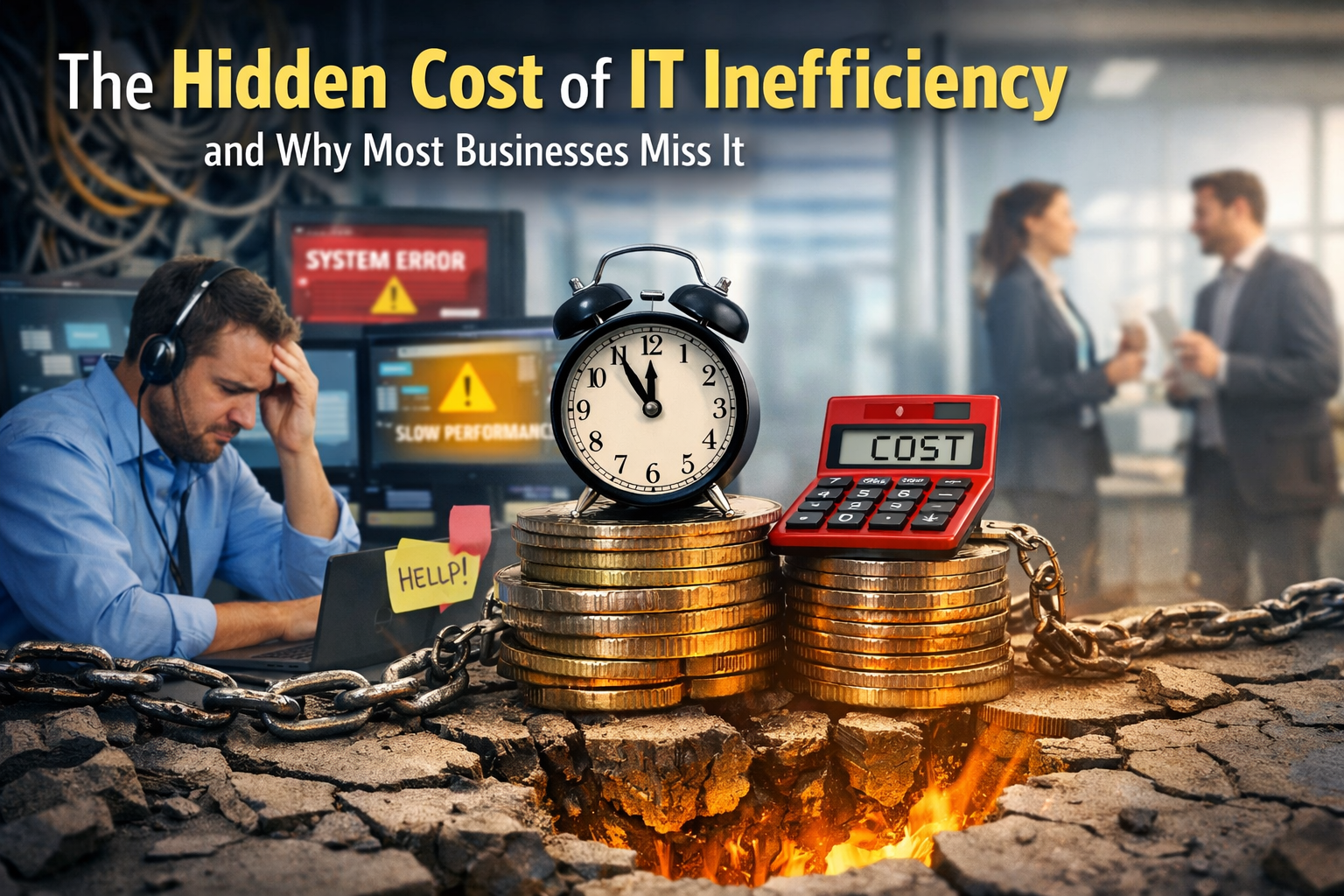
Most businesses believe their technology spending is reasonable. Budgets may increase year over year, but costs feel justified because systems are in place and operations continue.
The reality is different.
Many organizations are quietly overspending on IT without realizing it. The problem is not reckless spending. It is inefficiency that builds over time and remains unseen.
Hidden IT costs rarely show up as a single line item. They are spread across unused licenses, overlapping tools, outdated systems, and manual processes that were never re evaluated. Individually they appear manageable. Together they drain budget, reduce agility, and limit growth.
Why IT Costs Grow Without Delivering More Value
Technology environments change constantly. New tools are added to solve immediate problems. Teams adopt platforms to move faster. Systems evolve as the business grows.
What rarely happens is a structured review of what is still needed and what is no longer delivering value.
Over time, organizations end up paying for:
- Software that is rarely used
- Multiple platforms performing the same function
- Legacy systems that require ongoing support
- Manual workflows that increase labor cost
- Technology decisions that were never revisited
- Costs increase, but outcomes stay flat.
This is how inefficiency becomes normalized.
Hidden IT Costs Are a Visibility Problem
Most businesses are not intentionally overspending. They simply lack visibility into how technology is actually being used.
Spending becomes fragmented across departments, vendors, and contracts. Leadership sees total spend but not effectiveness. IT teams focus on keeping systems running, not evaluating cost efficiency.
Without visibility, waste hides in plain sight.
By the time budget pressure appears, inefficiency is already embedded into daily operations.
The Real Business Impact of IT Inefficiency
Hidden IT costs impact far more than the technology budget.
Unchecked inefficiency leads to:
- Higher operating expenses
- Slower teams and reduced productivity
- Less capital available for growth initiatives
- Continued reliance on outdated systems
- Increased risk from unsupported or misaligned technology
When inefficiency compounds, organizations pay more while getting less.
This is why cost control efforts often fail when they focus only on cutting spend instead of improving efficiency.
What an IT Cost Assessment Actually Evaluates
An IT cost assessment goes beyond reviewing invoices or contracts.
It evaluates:
- How technology is being used across the organization
- Where spending is misaligned with actual needs
- Which tools or systems are underutilized or redundant
- Where manual processes are driving unnecessary labor cost
- How technology decisions impact efficiency and risk
The goal is not to reduce capability. It is to eliminate waste and improve alignment.
This approach supports technology cost reduction and IT cost optimization without disrupting operations.
Why Cost Optimization Is Not About Cutting Tools
One of the biggest misconceptions about cost optimization is that it means removing tools or reducing headcount.
In reality, effective cost optimization focuses on:
- Removing redundancy
- Improving process efficiency
- Aligning tools to actual usage
- Eliminating unnecessary complexity
Organizations that approach cost optimization strategically often improve performance while reducing spend.
Efficiency creates capacity.
When Is the Right Time to Review IT Costs
Most organizations wait too long.
Common triggers include:
- Budget constraints
- Rapid growth
- Mergers or system changes
- New leadership
- Pressure to invest in AI or cloud initiatives
The best time to review IT costs is before these pressures force reactive decisions.
A proactive IT cost assessment provides clarity and control before inefficiency becomes costly.
Regaining Control Starts With Visibility
Cost control is not about guessing where savings exist. It is about understanding how technology supports the business today.
An IT cost assessment gives leadership:
- Clear visibility into spending
- Insight into inefficiencies
- A roadmap for smarter technology decisions
Once visibility improves, savings follow naturally.
Hidden IT costs do not fix themselves. Without visibility, inefficiency continues to grow.
Start your IT Cost and Efficiency Assessment today and uncover where technology waste may be limiting your business.
Frequently Asked Questions
What are hidden IT costs?
Hidden IT costs include unused software, overlapping tools, inefficient processes, and outdated systems that quietly increase spending without adding value.
How does an IT cost assessment help reduce costs?
It identifies waste, inefficiencies, and misalignment so organizations can reduce spend while improving performance.
Is an IT cost assessment disruptive?
No. The assessment focuses on visibility and alignment without interrupting daily operations.
Does cost optimization mean reducing services?
No. The goal is to eliminate unnecessary cost while maintaining or improving capability.
| Discover Trusted Managed IT Services Near You
|